
Spaceship Earth
It is easy to forget we are hurtling through the universe on a ball of silicon and steel. Yet, if you can travel out far enough and see our ‘pale blue dot’ in the vastness of space, you’ll get a new perspective.
We live on a flying space rock hurtling through the universe.
I was listening to a conversation with the comedian Pete Holmes who offhandedly said something like the above, and ever since then, this image has never left my imagination: we live on a flying space rock.
It is easy to forget we are flying through the universe on a ball of silicon and steel. After all, when I look around, all I can see is the stretch of land in front of me and the sky above me, tucking my reality into a neat, little bubble. Yet, if you can travel out far enough and see our ‘pale blue dot’ in the vastness of space, you’ll get a new perspective.
Buckle up, we are flying around the sun at 67,000 miles per hour. And our solar system is moving at a cruising speed of 448,000 miles per hour around a black hole. And our galaxy is moving at 1.3 million miles per hour through the vastness of the universe. This flying space rock of ours is hauling.
It is funny to bring this idea up because it’s kind of absurd. That is why Holmes uses it as a punchline. But Holmes owes the germ of his comedic insight to the author George Orwell who wrote back in 1937, “The world is a raft sailing through space.”
What a magical image! This space rock of ours is really a vessel, and we are all aboard.
The futurist Richard Buckminster Fuller further popularized this image in his book Operating Manual for Spaceship Earth. While human power struggles abound, and while resources are spread unevenly across the globe, we are, in the end, all in this together. “We are all astronauts,” he wrote.
Not only are we all aboard the same spaceship, but we are also all one big human family. The study of human genetics has concluded that every human alive comes from the same great, great, great, great grandmother, Mitochondrial Eve. We all come from the same set of brothers and sisters. Every human on earth has an invitation to the biggest family potluck ever to be thrown.
The ancient Hebrew scriptures proposed the same idea; that every tribe and nation ultimately came from one family, and that every conflict between tribes is really a sibling rivalry gone awry.
The Christian scriptures share a vision of a renewed earth where every tribe and nation is unified around the Christ, the cosmic King, who is making the many into one. This type of globalism isn’t about taking away the autonomy or uniqueness of any particular nation. In the last pages of the Bible, we don’t find a borg like humanity flattened out of its cultural uniqueness, rather we find the wonderful autonomy and diversity of all human nations working together with their unique gifts.
If we can step back and see our planet in a new light, maybe we can learn to trust each other and work together.
Richard Buckminster Fuller popularized the phrase “spaceship earth” to give us a global perspective. He also made a unique contribution to cartography to the same end. Since the earth is a globe, if you want to print it on a piece of paper you have to cut the globe apart and flatten it out, what we call map projections. There are many different techniques for this, and each has its own compromises.
The most famous map projection is the Mercator projection.

Mercator Projection
In this map, up is north, down is south, and the shape of continents remain accurate. It makes it an excellent map for navigation. The downside of this projection is that the farther from the equator the more landmass is inflated in size. This makes Greenland the size of South America (even though it is really 1/10 the size).
A map projection that keeps the sizes of landmasses more accurate is the Hammer projection, made by Ernst Hammer in 1892. But notice that with both of these projections there is vast stretches of ocean separating us from each other.
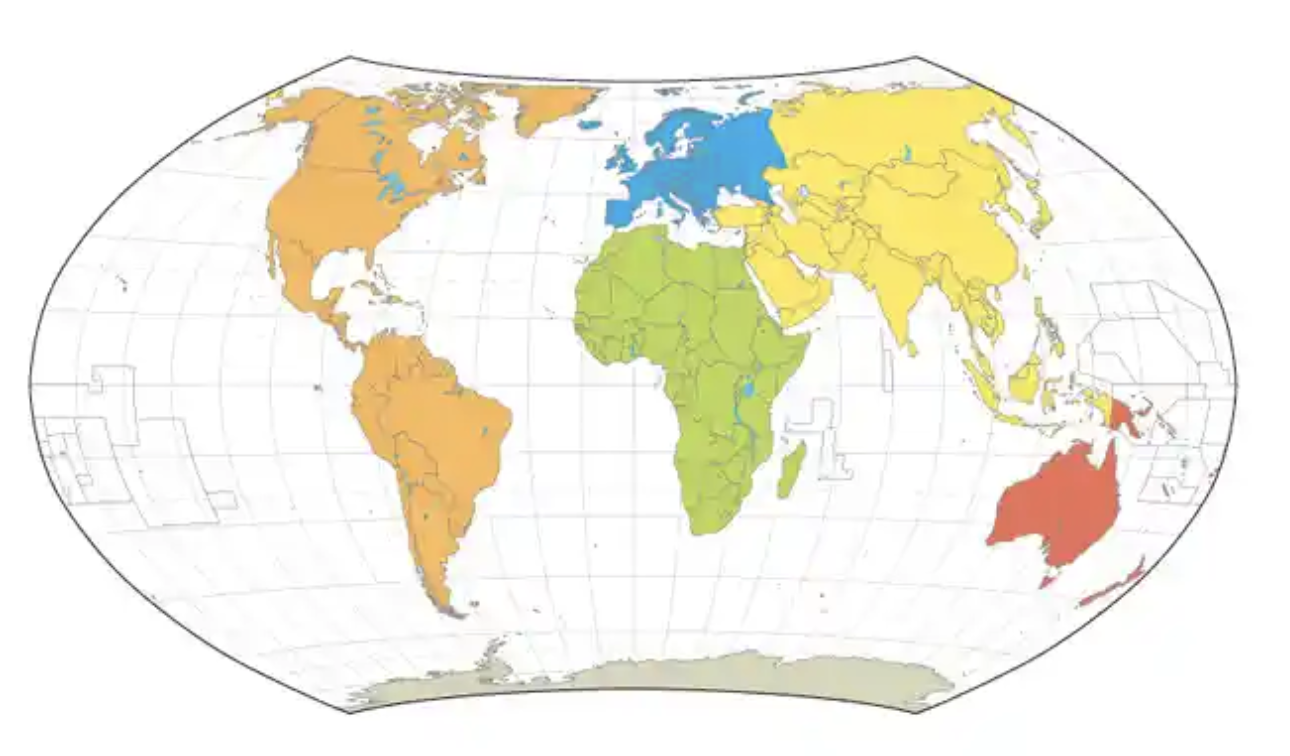
Hammer Projection
Enter our friend Richard Buckminster Fuller, who architected a new map called the Fuller Projection, or the Dymaxion map, which doesn’t care about ‘up and down’ at all (which are relative ideas anyway.)

Fuller Projection
This projection has a few unique advantages. First, it has less distortion of landmass compared to the Mercator projection. (Look at how Greenland is now clearly 1/10th the size of South America.) But most interesting, is that when unfolded like above, it shows that we aren’t on separate landmasses isolated from each other, rather we are one long stretch of land - one contiguous island.
The Fuller projection shows us that spaceship earth is one connected landmass shuttling through the unknown.
I love this map projection so much that I designed a poster to hang on my wall. You can download the full-res version here. I hope that as you look at spaceship earth through this lens, as one island planet, your imagination will allow you to remember that we are one large human family, in all our wonderful diversity.
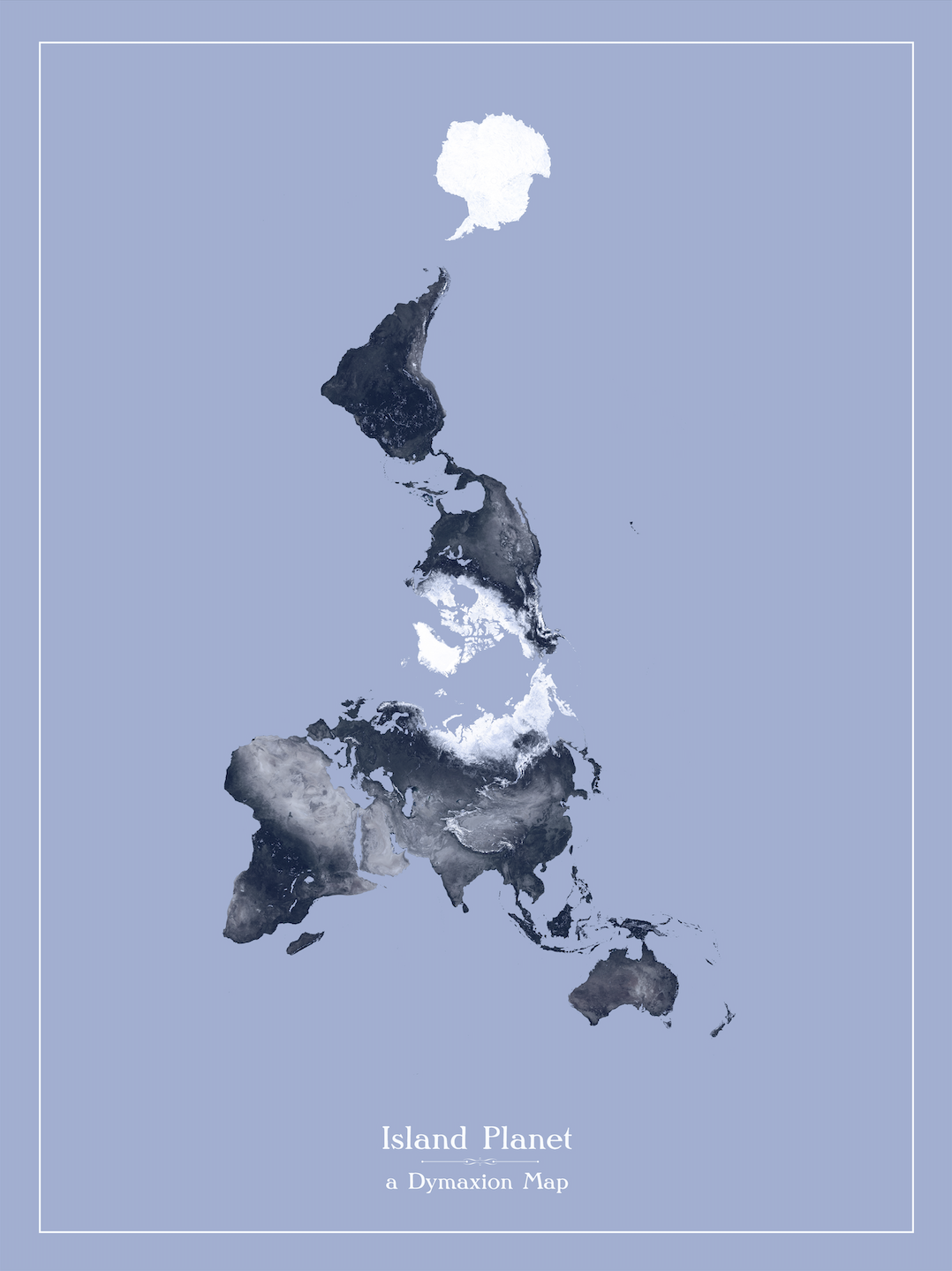
Island Planet

Understanding Story
Every story - no matter the character, no matter the setting, no matter the conflict and no matter the resolution - is always wrestling with this one underlying question: what happens when desire encounters resistance?
A Story is What Happens When Desire Encounters Resistance
You probably know the basic elements of a story: a setting, a character, a conflict and a resolution. Knowing these elements tell us what a story is made of, but it doesn’t tell us why these elements matter.
What kind of alchemy takes these elements and turns them into an enduring human artifact that brings so much magic and meaning to our lives? What is so special about a character, in a setting, resolving a conflict that is so indelible? Why do we crave it?
The reason is that a story is an examination of what happens when desire encounters resistance. And our lives can be boiled down to this phenomenon—I have desires, and I am constantly thwarted from realizing them fully. My life is the constant experience of desire encountering resistance, and a story gives me a way to explore in vivid detail different ways to navigate through it.
What Are Desires?
We all have desires—an urge to have something, a need for something not yet attained. All animals, including us humans are born with basic desires. We crave food, comfort, and security. Yet Humans develop more complicated desires. We crave meaning, adventure, intimacy and wisdom. These desires flow through us like a spring flowing through the earth.
Human desire is powerful and mysterious. Some desires are so familiar we don’t think about them, like breathing. Other desires are surprising and strange and feel foreign to us. Some desires are overwhelmingly powerful, like the desire for revenge. Other desires hum quietly in the background making tiny, unnoticed adjustments to every decision we make.
Desires meet a lot of different type of resistance. Your circumstances can keep you from your desires. Other people can keep you from your desires. Even more confusingly, you can have contradictory desires waging war in your own psyche.
It is frustrating when our desires encounter resistance. But imagine a world where you get everything you desire. Is it paradise? Surprisingly, it isn't. We are fortunate to live in a world where our every desires isn’t magically materialized. We are shaped by the resistance we experience just as much as we are shaped by our desires.
But how do we navigate all of this? We are born into this world with a web of nuanced, vibrant, often contradictory desires that confront a matrix of resistance, and despite the complexity that this creates we long for a roadmap for what to do with all of it. If there was a a instruction manual to human desire it would be bigger than any library could hold and longer than any human could read.
This is where stories are uniquely useful. Every story is a thought experiment about what happens when desire encounters resistance. Stories don’t pretend to be comprehensive instruction manuals. Instead, stories are a virtual reality, an immersive way to become more familiar with the terrain of our own worlds.
Is this an oversimplification? Surely stories do more than just explore what happens when desire encounters resistance. Yes. Stories do a lot more. But every other function of a story is optional. This function is mandatory. Let’s take a look:
Every Story Needs Desire
First of all, we know one basic element of a story is a character. But why do stories need characters? Characters are in stories because characters have desires. A character could be a person, an animal, or even a toaster. Whatever it is, if it has a desire it is a character. Without a character who desires something we don't have a story.
Every Story Needs Resistance to Desire
A character with a desire is not enough to make a story. The story needs to have resistance to that desire. Conflict in a story is simply resistance to a character’s desire.
“Kristi was happy.”
Does this sentence feel like a story? Not really. It just feels like information. Kristi has a desire but no resistance to that desire.
“Kristi was happy until she met Mark”
Ah, there we go. We are now in the world of a story. Do you feel the difference? Now you want to know more. Why is Kristi’s desire finding resistance in Mark? And what is going to happen because of the resistance?
Resistance to desire doesn’t have to come from a character. It can come from anything: the environment, circumstances, or even other internal desires.
“Kristi was happy until she put on her lipstick.”
That sentence is the beginning of a potentially interesting story. We don’t know why the act of putting on lipstick has become a form of resistance to Kristi, but we want to know why. And we want to know what will happen.
A Story Needs a ‘What Happens’
We have desire, always embodied by a character, and we have resistance to the desire—also known as conflict. But we don’t have a completed story until we learn what happens. What happens when desire encounters resistance? This is what we are ultimately concerned with.
A character in a story is generally driven by one main desire that will eventually come to some sort of resolution. This is the story arch that holds the entire story together. However, every beat of a story is driven forward by the same formula in big and small ways, pushing every character forward through a myriad of unanticipated situations.
When we see what happens to these characters we get a deeper understanding of how desire and resistance works. Every story is like a fragment of a map. We will never get a completed map, and so we will never get tired of stories.
Desire, resistance, and resolution. These are the building blocks of story. When we view story this way we don’t just learn what a story is composed of, we also discover why a story matters. A story is a the lab results of desire encountering resistance in new ways.
Your Life is Desire Encountering Resistance.
You are here living on this planet, and you have desires. A lot of them. You don’t understand all of your desires. You are not even consciously aware of all of them. You constantly experience resistance to many of your desires. You even experience conflict between your own competing desires. Experiencing desire and encountering resistance is not just the basic building blocks of story, it is also the basic building blocks of our own existence. Your life can be described as the series of results from a web of desires encountering a matrix of resistance.
We relish the opportunity to hear stories of what happens when others are confronted with this same reality that we encounter. Stories helps us feel connected to others. Stories let us see the common thread of existence that runs through all of us. Stories are also fun. They are scratching a primal itch. They are guiding us into new worlds. But most importantly, stories are a virtual reality. Stories help us think about our experiences in new ways. Stories allow us to troubleshoot ourselves. Experiencing a story is harvesting a bounty of budded perspectives about what it means to be a creature that desires.

Jonathan Collins
I resides in Portland, OR with my wife and two sons. I'm a co-founder of The Bible Project and Epipheo. My mission is to Explore and Explain

Starting Again
Last month I walked away from my businesses, everything I had worked for in the past seven years, I sold it back. I’m done.
I hate to quit. But sometimes you need to.
"There are two things economists love to talk about that will help us understand quitting. One is called “sunk cost” and the other is “opportunity cost.” “Sunk cost” is about the past — it’s the time, or money, or sweat equity that you’ve put into something, which makes it hard to abandon. “Opportunity cost” is about the future. It means that for every hour or dollar you spend on one thing, you’re giving up the opportunity to spend that hour or dollar on something else — something that might make your life better. If only you weren’t so worried about the sunk cost. If only you could quit."
- Stephen Dubner - The Upside of Quitting
Last month I walked away from my businesses, everything I had worked for in the past seven years, I sold it back. I’m done.
This wasn’t sudden. I had been planning it for nearly a year. I had been thinking about it for much longer than that. I repeatedly tried to find reasons to not quit. I hate to quit things. I’m scared of quitting things. But I had to do it.
I had to do it but… Financially it didn’t make sense. Career wise it also was arguably foolish. It put a strain on important relationships in my life. And it left me feeling like I was starting over.
So why did I do it? Great question. My therapist and I will be working through that question for a while I imagine.
I could tell you all the things I was trying to get away from, and there were plenty of those. But there will always be things in life that are difficult, and I can’t run away from them all, nor should I. What really got me to quit was what I am running towards. It is the thing I’ve been running towards for a long time now.
---
From Pastor to Explainer
After college I was working at a church as a Pastor. I was twenty-four, newly married. I was in charge of about a hundred or so people who didn’t quite fit into the church but still wanted to hang around and figure it out. I loved that group. I also loved, as the leader, to learn about important things in life and try to teach those things so we could somehow wholeheartedly follow God together. But as a Pastor I felt looked to as more than just someone exploring the world and explaining it to others. I felt looked to as having answers and needing to model a godly life. The problem was I knew I didn’t have answers, and I saw myself trying to be someone I couldn’t live up to. It scared me. So I quit. It was a hard decision. I decided not to lead. I was too young I told myself.
While I was leaving, a mentor at the time, the man who was taking over my job, asked me while we sat in my half-packed office, “If you could do anything and money wasn’t an option what would you do?” I didn’t have to think about the question. “I would make documentaries” I said.
In my mind, a documentarian doesn’t have to pretend to be anyone. He gets to be himself. He doesn't have to have answers. He helps people by asking questions. It was a pastoral hack. A way to help people without responsibility. A way to lead without really leading.
He hired me, right there, to make an explainer for his ministry called Skate Church. He bought a camera. I bought a computer and Final Cut Pro. I started watching tutorials online about how to use these things. I spent a few years learning by working on any video project I was entrusted with. I found I had a knack for helping people understand things visually and ultimately found success in the craft.
However, I didn’t know how to build a company. And I had no real desire to lead one. So I gave what I was working for over to some friends. Over the next seven years I built two businesses with good people who had very different visions than me.
Both of these businesses grew rapidly. It was a thrill. I worked harder than I ever had. I walked into rooms I felt I had no business being in. I learned to make decisions I felt no business making. I had to learn how to negotiate. I had to learn how to sell. I had to learn how to hire people. I had to learn how to fire people. All these things scared me. And I’m glad I learned them.
All the while the work we were doing drifted far from the kind of work I wanted to do. This irritated me. So much so that I wanted to quit. However, I soothed myself with two facts: First, I was making money and secondly I was learning business. These are two tools that I might as well seize. Strike while the iron it hot. Right? In the meantime I believed I could somehow instill my values and vision into the company.
I advocated for what I wanted in the business. But it wasn’t understood, which was weird from me, I mean I’m good at explaining things, that is what I do. But I didn't explain it well enough, or perhaps it didn't matter how well I explained it.
I got depressed. I started to fantasize about leaving the country. In fact, at one point I did leave the country, for an entire month, me and my family in a beach house off of a beaten dirt road in Costa Rica. It was a magical time. I thought I had finally gotten myself out of the business. I was ready to begin what was next. I was wrong.
The business needed me. Or so it said. I obliged to come back and jump in again.
Things never really got better. I got more depressed. At one point I began to fantasize about getting hurt. Nothing so bad that I would be in any real danger. But bad enough that I would be hospitalized and couldn’t work anymore. What a dumb fantasy. I would wake up in the middle of the night with my mind racing about things I didn’t want to care about but couldn't stop thinking about. I started asking Tristen if I was having a mental breakdown yet. I was waiting for, hoping for something dramatic to happen that forced me to quit. But nothing like that came to be.
I'm painting a bleak picture here. I know. It wasn’t always so bad. There were seasons I felt like things could change. I was still learning a lot. I heard what I wanted to hear. I held in there and kept working to grow the business. At times it was even really fun. And I hate to quit things. I think I mentioned that.
---
Confronting Passivity
I wanted the business to care about my convictions but I didn't want to lead. This is a joke. About two years ago I became convicted of this passivity and realized it was a problem. I asked to become chairmen of the board, which happened, and I even advocated that I be made CEO of the company, which wasn’t taken very seriously, but I believed I was ready and that was a big step for me.
When I stopped being passive I started to see things more clearly. During this time it became undeniably obvious that what we had built was not compatible with my vision for my vocation. I also learned, more importantly, that while I can’t be passive I shouldn’t try to change the company to fit my vision. I decided to let my partners have the business for their vision and not mine. I felt content with this decision. But I didn't know what that meant practically.
I was complaining to one of my good friends, a gentle creative man who knows me better than most, and he looked at me sternly and said, “Jon, go to the mountain and be with God.” So we went together, up to Mount Hood and stayed at a small cabin with a wood paneled room heated by a wood stove. I turned off my phone for the first time in years, and I spent two days with God.
Surprisingly, or I suppose I should say unsurprisingly, God met me there. It was a rich time. I sat at a river bank trying to figure out what to pray. My mind kept wandering with relentless distraction and unease. And suddenly it occurred to me that I should pray about what I was grateful for. I did, and it made me break down in tears of joy.
That weekend God told me I was afraid of leading and that he wants me to lead. I needed to stop being afraid. I decided to believe Him. And I knew I had to quit.
---
The Next Chapter
That was eight months ago. It takes a while to step out of businesses wisely. But it finally happened. I have to say goodbye to people and ideas that I once held very dear. To my partners, I am very grateful for everything and sad I can't be in the trenches with you all. To the creatives, I wish had truly led from the beginning.
I'm starting over. But really, I am not starting over. I’m just starting again. I have the same vision I’ve had from the beginning. This time I start with more than just passion and grit. This time I start with the resolute (if still yet timid) conviction to be a leader.
---
I don't know exactly what I'm doing with my career. But right now I'm working on a crowd-funded non-profit called The Bible Project. Feel free to check out the work we are doing on our YouTube channel. It is my way to explore the world through the perspective of an ancient book many believe is God's word to us.

Jonathan Collins resides in Portland, OR with his wife and two sons. He is a co-founder of The Bible Project, Epipheo, and Sincerely Truman. He enjoys turning ideas into realities, writing, speaking and breakfast burritos.

The Power of Metaphors
Your day-to-day language is drenched in metaphors that you aren't aware of. These hidden metaphors shape the way you think
Your day-to-day language is drenched in metaphors that you aren't aware of. These hidden metaphors both shape the way you think about the world and affect your behavior. They do this quietly, often subversively, and always powerfully. I’ve unwittingly adopted metaphors that have caused me to behave in ways that aren’t healthy.
This idea was first presented to my by George Lakoff and Mark Johnson in their influential book Metaphors We Live By. This post is influenced by their work along with an essay from C.S. Lewis discussing the necessity of thinking metaphorically. That essay is called “Bluspels and Flalanspheres: A Semantic Nightmare” and can be found in the book C.S. Lewis Selected Essays.
If our thinking is true then the metaphors by which we think must be good metaphors - CS Lewis
This post is to encourage you to uncover the secret metaphors embedded in your thoughts that shape who you are.
Metaphors are Comparisons
A metaphor is a way to compare two things. For example, “When I’m with you I’m at home” is a phrase with the embedded metaphor you are my home. If I said this to my wife I would not mean that she is literally the place where I reside. That doesn’t make any sense. But it isn’t literal. It is a comparison. It is metaphorical.
Metaphors Create Meaning and Define Reality
Metaphors go beyond saying what something is literally and begin to tell you why that thing matters. As a metaphor, you are my home creates meaning of our relationship. My wife is a person with whom I can unwind, rest, or retreat.
Metaphors not only create meaning but they define your reality. Accepting a metaphor makes you focus in on the things that the metaphor highlights and ignore other aspects. Metaphors, even if they are not true, can become self-fulling prophecies. Most astonishingly is this—our metaphors will change our behavior.
Take for example the phrase, “I don’t follow your argument". Embedded in this phrase is a conceptual metaphor that an argument is a path. You can see this metaphor in the phrases, “I don’t like your train of thought” and “you are straying from the line of the argument.” Like a path, an argument should lead you somewhere. It is nice to think about an argument as a path. Paths are very utilitarian. Two people can take a path together. We can blaze new trails.
When Metaphors Compete
However, there is a competing metaphor more prevalent in our language which is argument is war. We see this metaphor at work when we say things like “here is my counter argument”, “your point of view is indefensible”, “his criticism was right on target” or simply “I won that debate”.
These two metaphors - argument is a path and argument is war - compete with each other. Following or creating a path can be cooperative. But a battle is combative. A path can be useful for anyone to use. But waging a war is always at the expense of someone.
The difference between a healthy discussion and a heated fight could be a poorly accepted metaphor.
Metaphors are Not Just for Poets
The most important things in life are abstract: love, hope, peace, intimacy, adventure, friendship. An abstract is something that is impossible to talk about literally and instead have to talk about what it is like—we have to compare it with something else. This act of comparing is the creation of a metaphor. We are always using and creating metaphors to understand ourselves and the world around us.
It is easy to simply categorize metaphors as a nice trick that poets and storytellers use to tempt us into thinking about things in new and interesting ways. But it turns out that metaphors are not just parlor tricks. Metaphors are a fundamental part of how we think about almost everything we experience.
C.S. Lewis points out in his essay “Bluspels and Flalanspheres: A Semantic Nightmare” that all language has a figurative origin and that it is impossible to think and write in a meaningful way without using metaphors. He goes so far as to say,
“Those who have prided themselves in being literal, and who have endeavoured to speak plainly, with no mystical tomfoolery, about the highest abstractions, will be found to be among the least significant of writers… But open your Plato, and you will find yourself among the great creators of metaphor, and therefore among the masters of meaning.”
Metaphors are Sneaky
The difference between a simili and a metaphor is that a simili will clearly announce that it is using a comparison with the word “like”: “this is like that”. A metaphor is doing the same comparative work as a simili, however it is much sneakier. It drops the word “like” and boldly says “this is that”.
As a result, metaphor can be confused as an attempt to be literal. It is easy to begin to trust metaphors as literal things forgetting that the idea originated as a non-literal comparison. In fact, many words we have today came directly from metaphors that we take for granted.
A good example of this is our word spirit comes from the Latin Spiritus which means breath. In Greek the word for spirit also means breath or wind. Deeply embedded in our language the metaphor spirit is breath. This metaphor forms the way we think about our humanity and our spirituality.
I personally think it is a good metaphor. It is better than (and competitive with) another metaphor that is becoming very popular - our minds are computers. That new metaphor is sneaking in our language as we talk about computers having ‘memory’, ‘processing power’, and being either ‘awake’ or ‘asleep’.
Since metaphors are sneaky they easily place themselves into our language and become unconscious mental guides by which we make meaning out of our experiences. Lakoff and Johnson call them “conceptual metaphors”. They are a clandestine force informing how you should think and how you should act.
Examining Our Metaphors
Metaphors are abundant, sneaky, and formative to our lives, but there is nothing sacred about our metaphors. Metaphors are not literal. They are not truth. We should feel free to discard both boring and dangerous metaphors and readily adopt new ones. We should examine all of our metaphors making sure they are coherent with everything else we believe. We should actively create new metaphors.
Here is C.S. Lewis again,
“He who would increase the meaning and decrease the meaningless verbiage in his own speech and writing, must do two things. He must become conscious of the fossilized metaphors in his words; and he must freely use new metaphors, which he creates for himself. The first depends on knowledge… the second on a certain degree of imaginative ability. The second is perhaps the more important of the two.”
Surprisingly imagination, which at one time looked like a childish activity suited for distraction or entertainment, now shows itself to be a crucial activity for living a healthy and meaningful life. Imagination enables us to break free from the slavery of dangerous metaphors.
Prophets appeal to our imagination. The role of a prophet is to get us to imagine life, ourself, god, as it really is an not as we are currently imagining it. - Ken Myers[2]
If imagination is that important then we should prioritize poetry, art, and storytelling. We should sharpen our imaginative tools and use their razor’s edge to slice into new territory.
A Few Metaphors to Re-Imagine
Here are a number of metaphors embedded in our language that I think might need some re-imagining. Some are really dangerous. Some are just stale. (Questions to ask: does the metaphor help or hinder my desire to be a fully human person? Does the metaphor align with my spiritual beliefs? Does the metaphor help or hurt myself and other people?)
“I fell in love” or “I am captivated by her” is from the metaphor love is a trap
“We are wasting time” is from the metaphor time is currency
“I can’t process that” is from the metaphor my mind is a computer
“My emotions flared up” is from the metaphor emotions are a disease
“I need to recharge” is from the metaphor my body is a battery
What else should be on this list?
Changing a Metaphor
I have had a deep belief in the metaphor that my emotions are disobedient children. I constantly talk to myself about my emotions the way I would talk to a two year old. “Calm Down.” “Keep Still.” “Don't overreact” I don’t value the things they say to me except to me. I worry that they will act out and embarrass me.
I not only think this about my emotions but also think it about other people’s emotions. This gets me in a lot of hot water, especially with my wife. Emotions are disobedient children is a dangerous metaphor that I learned somewhere along the line. It has taken the patience of my wife, some reflection, and some re-imagining to help me find a new metaphor.
Perhaps emotions are less like disobedient children and more like watch dogs. My emotions are the first to tell me when I am threatened, they raise the alarm when I need to pay attention to something suspect. If this new metaphor is true then I shouldn’t punish my emotions for creating a ruckus, sending them off to bed without dinner. Rather, I should make sure they are well fed and listen to them carefully.
If I’ve successfully changed my conceptual metaphor about emotions it should creep into my language. I should begin to hear myself say things like: “I wonder why I’m feeling scared.” Or, “I need to pay attention to how sad this is making me.”
This, of course, isn’t the perfect or ultimate metaphor for how to think about emotions. But it's a step in the right direction.
What Metaphors Have Crept into Your Life?
In order to find them you need to first accept that metaphors are prevalent and significant. Secondly, examine the language you use and trace it down to the conceptual metaphor that it stems from. And finally, if they are not good metaphors be brave and imagine new ones.
----------
1. This quote is from a lecture entitled "Imagination and Everyday Life" by Ken Myers which was part of a conference called Baptizing the Imagination. If you are interested in how imagination shapes us as humans I highly recommend all the lectures.

Jonathan Collins
I resides in Portland, OR with his wife and two sons. I am a a co-founder of The Bible Project and Epipheo. My mission is to explore and explain.



Pursue Pleasure
Do What Gives You Pleasure. Is that good advice?
Do What Gives You Pleasure.
Is that good advice? What if your idea of the pleasure is becoming a recluse on a warm tropical island? That’s a great vacation but it isn’t a happy life. Spend two weeks laying aimlessly on a beach and you will soon discover that you are bored and ready to do something meaningful. (Ok. Maybe three weeks.)
We desire pleasure but pleasure often disappoints.
Two Types of Pleasure
I was discussing this problem with Rick McKinley a Pastor in Portland and he told me that there are two types of pleasure. First, there are the simple pleasures. These are things like good Scotch, sleeping in, watching movies. There is a second type of pleasure which he called the pleasures of being. This type of pleasure is more complicated. It is the pleasure you get when do something you feel you were particularly designed to be doing.
It is important to enjoy Simple Pleasures like a picnic in the lawn or a good movie. Those pleasures give you a moment to recharge, reflect, and celebrate. But you can’t watch TV all day without feeling lazy. You can’t picnic in the lawn every day without feeling restless. If all you do is chase after simple pleasures you will find yourself disappointed. We crave a higher pleasure.
The Work of Pleasure
Simple pleasures are easy. They don’t require much of anything from us. They come and go quickly. Pleasures of being take work. And this is where we get hung up. We’ve equated things that are pleasurable with things that are easy. Yet the truest, deepest pleasures are incredibly hard to achieve:
Like the pleasure of a close friend who knows you well
Or the pleasure of a long fought project that is coming together
Or the pleasure of seeing your family enjoying time together
The most pleasurable things in life take the most amount of work.
When someone says “Do what Gives You Pleasure” they don’t mean “Aim for the Easy Life". At least I hope they don’t. Because pursuing pleasure is not easy. It is the hardest and most satisfying human endeavor we have.
Pursue Pleasure
Look deeply into what you are uniquely designed for. What does your spirit crave? What type of work gives you joy? And then do the work that pleasure requires.

Jonathan Collins
I resides in Portland, OR with my wife and two sons. I'm a co-founder of The Bible Project and Epipheo. My mission is to Explore and Explain

Networking for Introverts
I once read this tweet about how important networking is:
“If you fail to introduce yourself to someone it could cost you a million dollars”
That tweet terrified me because I'm an introvert.
The Power of Networking:
I once read this tweet about how important networking is:
“If you fail to introduce yourself to someone it at least cost you a friend and could at most cost you a million dollars”
Being a bad networker could cost you a million dollar opportunity. The tweet really scares me because I believe it is true. Meeting the right person could change your life. The reason it scares me is because I hate networking. I’m an introvert. When I meet someone new I don’t think, “wow, meeting this person is a great opportunity”. Instead I think, “wow, meeting this person is a lot of work and I’d rather be by myself reading something”.
You wouldn't believe how many times I skip opportunities to network and then wallow in the fact that I'm letting opportunities pass me by.
Four years ago I attended the Mashable Social Good Conference in New York. I attended because my colleague Levi and I had made a video for Oren Jacob, a former director at Pixar and one of the presenters at the conference. Oren played the video during his talk. After the conference there was an invite-only dinner for presenters. We weren't invited, but Oren courageously marched Levi and I (along with my wife) up to the top floor of the Four Seasons Hotel and grabbed us a seat at the private dinner party. Oren is one of the most extraverted people I’ve ever met.
At the dinner was the CMO of Mashable, some New York Time columnists, some top marketing guy for Pepsi and on and on. What did I do? I talked with Oren and Levi the entire night about Finding Nemo. The whole night. Except the few times I was forced to hand one of my cheesy business cards to someone who wandered over and interrupted us. That dinner party might have been an extraverts dream but for me it was painful.
As I left New York I felt like I had blown a big opportunity. I should have passed out more business cards. I should have sold some videos right there and then. Maybe Mashable would have become a client. I probably blew a million dollar opportunity that night because I was too shy.
Is Networking only for Extraverts?
Maybe I have to put up with the fact that I’m a second-class networker in a world where bad networking can cost you a million bucks.
But then...
A few months back I was asked to speak on a panel for a networking event for the alumni of Whitmore College. One of the questions for the panel was “Why is networking important?” I read that question and cringed. I knew networking was important but I had nothing of value to say. I was ready to just admit that I’m horrible at networking and that somehow I succeeded anyway.
Then it occurred to me: Somehow I succeeded anyway. It got me thinking as to how an insecure introvert was able to succeed in an extraverts world. Here is what I shared on the panel.
An Introvert's Guide to Networking: Create value first. Network second.
If you are truly an introvert it is going to cost you way too much energy to network. Don't burn that energy on networking. Instead use that energy to build something of value. Then, after you created the value, networking will follow naturally.
I started Epipheo with three friends in 2009. Our goal was to make simple explainer videos that communicated the true value of products. That first year we were begging people to hire us. We spent $5000 on a list of emails so we could spam people about how awesome we were. We got a couple clients that way but nothing to sustain a company.
Then Google Wave came out. Google Wave is a web app Google was building in 2009. It was suppose to revolutionize the way we do email. It subsequently died a slow death and was abandoned by Google. But back in 2009 everyone was buzzing about it. Google Wave was in closed Beta and you could only get access if you were invited. So everyone on the internet was asking two questions: “How do I get an invite to Google Wave?”, and “what exactly is Google Wave anyway?”
The only thing that really explained Google Wave was a 90 minute presentation by the creators of the app. Only geeks who don’t socialize well with others watched the entire 90 minutes. I watched it. And I thought Google Wave was a fantastic idea. I realized I had the opportunity to create a short explanation of the true value of Google Wave. I wanted the video to show off what Epipheo could do. For the next two days I didn't go rub shoulders with anyone. I stayed at home in my spare bedroom and worked on that video.
I wasn't paid to do it. I just saw an opportunity to create value. One of my partners came over at around 9PM and by midnight we had finished up the animation, uploaded the video, sent a few emails out to tech blogs with a link, and went to bed. The next day it was shared all over the internet. Within two week it got us Google as a client.
What if I had tried to network with Google the old fashion way? I probably knew someone who knew someone who could get me a meeting with someone who might hire us if I said the right things. But that would have been a social nightmare for me and guaranteed not as impactful as the video. We didn't have to network our way into Google. Google reached out to us. Networking became a natural byproduct of the value the video had created.
When you build something you won’t always strike gold. But you eventually will create something of value. When you do doors will open up.
I left New York after the Social Good Conference feeling like a networking failure. But Mashable became a client anyway. The CMO saw the video we did for Oren and liked it. He saw the value.
So, You are an Introvert
Introverts are well suited for building things of value because we have the focus to sit down and work on something for long periods of time.
So while extraverts seem to have all the fun, make friends fast, and create opportunities with their charm, remember this: Introverts have the patience and focus to hunker down and create value. Do this quietly, do it consistently, and you will become a well connected person.

Jonathan Collins
I resides in Portland, OR with my wife and two sons. I'm a co-founder of The Bible Project and Epipheo. My mission is to Explore and Explain
Imagination VS Reason
We don’t design our lives based on reason. We design our lives based on our passions.
We don’t design our lives based on reason. We design our lives based on our passions. This is what Bertrand Russell meant when he said, “Reason is a slave to our passions.” I for one would like to think I am a reasonable person who makes decisions based purely on logic, but the human condition is such that our passions are what really run the show.
We don’t reason ourselves into our passions. Passions are instead fueled by our imagination— the ability to picture a world that doesn't yet exist but could. We are all imaginative. Whether you recognize it or not, your imagination is constantly humming away in the background trying to bind all your experiences into a coherent whole. Your imagination tells you what is important about life. It attaches meaning to every conversation, every object, and every moment. Your imagination is how you explain the past and how you envision the future. Imagination brings meaning to our lives.
Reason is the organ of truth, but imagination is the organ of meaning.” - C.S. Lewis
Here are a few ways our imagination work in tandem with our passions.
Our imaginations construct stories about the world that answer big questions about life. Why are some people bad and other people good? What is a successful life? What are virtues I should attain? These answers come from stories, either big, mythic tales or simple family narratives. We are told these stories from parents, pastors, books, tv, culture. And as we hear these stories our imaginations grab a hold of them and we filter life through them.
Our imaginations create heroes. In mid-century America imaginations were formed from mythic images like Marlon Brando on a motorcycle and Marilyn Monroe on a New York Sidewalk. For others their heroes are Mother Theresa or Batman. Your heroes might be celebrities you see on the magazine stands or someone you follow on twitter. Our imaginations are constantly at work to remake ourselves in the image of our heroes.
Our passions are formed by rituals. Rituals like family traditions, religious ceremonies, or summer vacations all shape how we think about who we are and what matters. Any ritual we participate in forms our imagination by making us active players in a story. Every time you participate in a ritual you are letting that ritual reinforce what you imagine life to be all about.
Our imaginations are formed by metaphors. Metaphors are an imaginative tool that explain something in light of something else. A modern metaphor many people use is comparing our brains to computers. “Let me process that” or “I need a mental reboot”. That kind of language comes from the the "My-Brain-Is-A-Computer Metaphor", and it shape the way we imagine ourselves and others around us.
The Slow Work of Shaping Your Imagination
Have you ever tried to change someone's mind with a well crafted argument just to find that the person doesn’t seem to care? Their imagination has already been shaped and reason isn’t going to suddenly reshape it. Yet we continually try to change people with reason. Why? Well, it is quick and exact. Reason is pointed and sharp. Like a knife. With reason you can explain things with precision and try to cut away error. And this is an important exercise in many contexts. But it doesn’t win people’s hearts.
Instead, think of your imagination like a star. Your imagination forms slowly over time and eventually grows hot and vibrant. You can’t cut into a star with a knife. You can only fuel a star with new stories, new heroes, new rituals, new metaphors, and eventually help reshape it. It’s a slow process remaking a star.
Don’t be cavalier about what stories you watch, what rituals you participate in, the heroes you adopt and the metaphors you use. These things are your leverage points. If you want to change your imagination start here.
If you are a teacher, a parent, or a communicator of any sort then pay attention to what is shaping the imaginations of the people you are educating. Help give them new inputs and be patient.
------------



Jonathan Collins
I resides in Portland, OR with my wife and two sons. I'm a co-founder of The Bible Project and Epipheo. My mission is to Explore and Explain
Play Like It's Your Job
I have a two year old boy, Pax. The only thing Pax has to do each day is play.
The Work of Play:
I have a two year old boy, Pax. The only thing Pax has to do each day is play. Trucks, books, blocks, spin in circles, chase the dog, jump off the couch, jump on me. The kid plays like it is his job.
It is his job. While playing he is learning skills that will make him a successful adult. He is a good little worker. He shows up everyday.
The thing about play is that it doesn’t feel like work. Play is fun. Time goes by quickly. Your mind is clear of distractions. You try new things without too much concern. You take risks. You explore.
The End of Play
When we get older a lot of our work stops being play. Adult tasks require us to hunker down and focus. No goofing around. No using your imagination. No trying new things. No expelling unnecessary energy. Just get the job done.
But more and more that kind of work is taken away from humans and given to machines because machines are better at it than us.
Some Advice
Don’t try to outperform machines.
You are Human
Do what humans do best. Play. Take risks. Use your imagination. Spin in circles just to see how it feels. Play like it is your job.
In 2004 I decided that I wanted to learn how to tell stories with video. I didn't know how to film, edit, or do anything really, so I decided I would enter a season of play. Instead of spending 80K on art school I spent 8K and bought a video camera, a Macbook, and a copy of Final Cut Pro. Then I started playing. I edited a friend's wedding video. I needed to rent out our house so I made a video tour and put it on YouTube. I put a link to the tour with the craigslist ad. It got us a lot of applications and could have turned into a business. But I was still playing. I spent a year putting way too much effort into a promotional video for a non-profit. I did all this because it was fun. I did it playfully.
Play is hard work when you are focused. But it doesn't feel like work.
I discovered that I had a knack for storytelling with video. My projects had limits due to small production budgets and my lack of experience, but these limits forced me to be creative. I figured out cheap and unique ways to tell stories with simple animations. I learned what parts of the process I was good at and what parts I wasn't so good at. I learned how to rely on my strengths and create interesting things.
That season of play spun into a freelance gig, which evenutally launched a small studio, which has now turned into a large creative agency.
Play can be really productive.
It was easy to justify that season of play because I felt like I was saving money by not going to art school. I was also in my early twenties and it is common to "discover yourself" during that time.
But other times it is hard to justify play.
As my business grew I noticed I wasn't playing much anymore. I was grinding it out. I began to wonder if the lack of play is what being an adult is all about. I'm not in my twenties. I have a family. I have a mortgage. I can't take as many risks. I have lots of reasons to not play around anymore
But then I realized that this is nonsense. If I don't play I won't discover new ways to create value. If I rely on doing redundant tasks I won't innovate. I 'll lose my job to competition. Or I'll one day be replaced by a machine.
I decided to prioritize play again. I created space in my schedule. I chose two projects to play around with. One of those projects really does feel like spinning in circles just to see how it feels. I'm not sure if either project will be amazing or unimpressive. But that isn't the point of play. The point is to play.
A New Paradigm
Play-work requires a different paradigm than work-work. Since it has been a while since we've been children lets have a refresher on how to play:
Tip #1 Have goals but don't have standards. It is ok that your play has goals. These goals can be something like, "try to climb that tree to the very top." or "write a story". But you can't really play when there is too much at stake. Create situations where it is ok to do something lousy. When you aren't focused on performing to some standard you can lose yourself in play.
Tip #2 Don't be efficient. Take risks on stuff and throw things away without concern. At the end of the day you were just playing around, and not all play is productive. But lots is.
Tip #3: Get incredibly curious. Start to think like a kid again. Read things without an agenda. Ask questions that might sound stupid. Pull things apart just to see how they work.
Tip #4: Make limitations assets. When you are a kid and you don't have a basketball hoop you just turn a bucket into the goal. You build stuff out of what is in your parent's garage. You make due with what you have. You come up with interesting things this way.
Tip #5: Give yourself a shot clock. Lots of games have some sort of shot clock in which you have a limited amount of time to score your points. This requires you to get creative and try new things when you are running out of time. In other words: deadlines.
Set some time aside everyday to play. And then do the work of play like its your job.
You might also like
Your day-to-day language is drenched in metaphors that you aren't aware of. These hidden metaphors shape the way you think